We need to understand a problem to solve it. Sometimes, going back to basics and building our understanding up from first principles will help us find that solution.
Understanding is learning
To understand is to know what to do.
Wittgenstein
I don’t know what’s the matter with people: they don’t learn by understanding; they learn by some other way – by rote, or something. Their knowledge is so fragile!
Richard Feynman
[Y]ou can’t really know anything if you just remember isolated facts and try and bang ’em back. If the facts don’t hang together on a latticework of theory, you don’t have them in a usable form.
Charlie Munger
Do you ever find yourself trying to learn something, but you can’t get it to stick? Maybe you’re trying to memorise the puzzle piece instead of understanding how the pieces fit together.
Memory is the process we use to acquire new information, store it, and retrieve it when needed. When acquiring information, we’re transferring our experiences of the world to our short-term memory[i] (think, 5-7 seconds) and then to our long-term memory. We then retrieve or recall information from our long-term memory.
There are a few ways to improve our ability to retrieve information from our memory. One way is understanding why something works the way it does. When we understand something, we attach meaning to it and categorise it in our memory.
Ray Dalio, who ran the best performing modern hedge fund in the world, often talks about his weakness for rote memorization.
My most obvious weakness was my bad rote memory. I couldn’t, and still can’t, remember facts that don’t have reasons for being what they are (like phone numbers), and I don’t like following instructions. At the same time, I was very curious and loved to figure things out for myself, though that was less obvious at the time.
Despite this so-called ‘weakness’, he is one of my favourite thinkers and communicators. The way he can describe complex systems is amazing. His video on how the economic machine works is a fine example of first principle thinking (and one of the best ways of understanding the macroeconomy).
Writing and talking helps consolidate what you learn. Warren Buffet and Charlie Munger, they would read and then talk to each other about ideas. Marc Andreessen does something similar. For me, I like to write things. So do most writers, I’d imagine. Both are useful ways of thinking – or processing information in our brain – just figure out what you like and go with it.
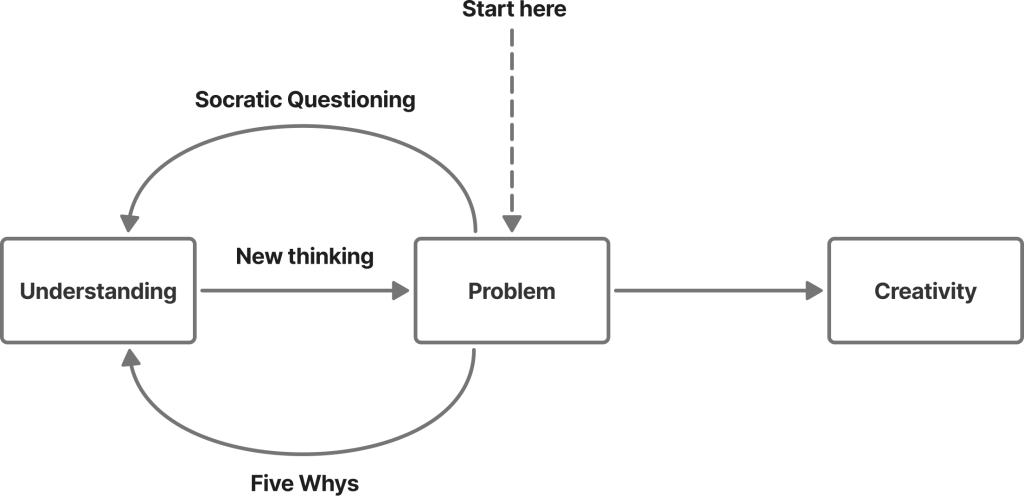
Two techniques
Once we’ve broken something down to its basic elements, we can identify new ways of doing it. As Farnham Street’s article explains
“Reasoning from first principles,” [is] a tool to help break down complicated problems by separating what we know is absolutely true from anything that is an assumption. What remains are the essentials. If you know the first principles of something, you can build the rest of your knowledge around them to produce something new.
Often you don’t need to get too deep, just further than most people go. There are two ways of doing it.
- Socratic Questioning: Named after the ancient Greek philosopher Socrates, this style of questioning aims to get at the core of a problem by asking open-ended questions that are targeted at going deeper and actively listening.
- Five Whys: An easy one to remember, the Five Whys is a type of root cause analysis used to determine the underlying cause of a problem.Basically, it means that when searching for the reason, even after you’ve found one, do not stop. Instead, keep asking until you’ve uncovered the underlying cause. It might not take five tries, but the point is you need to go beyond the typical one or two tries.
[i] Sometimes called working memory.

